Friday, April 18, 2014

The Trip Down

Some of the adventure of living part-time in Banámichi includes traveling there from Tucson. The trip  has become somewhat routine with time, but there are still enough surprises each time to keep it interesting.  And it is definitely an experience of Mexican culture. The atmosphere immediately changes when we cross that imaginary line in the desert called "la frontera"...the border.

Heading for the border
We generally cross at the Mariposa truck crossing in Nogales, Arizona. Abruptly, signs are in Spanish and the required lane changes are chaotic and confusing. We soon encounter a customs station where you might or might not get a green light. Getting a red light means an encounter with a very polite young customs officer who mostly just does a cursory inspection and waves us on our way with the words "Que les vayan bien!" (May you travel well.) At milemarker 21 kilometer, there is a second station for obtaining visas and car permits. Since Banámichi is not in the so-called "free zone," every 6 months we have to stop and get new car papers and leave a $400 deposit for our vehicle. The process is complicated, and on a busy day, time consuming.

Nothing to Declare  Lane? This guy got a red light!
First you stand in line to fill out the visa form, then you head to the bank and wait in line to pay for the visa. Then you go back and stand in line to get the visa stamped. Then its on to the copy booth for copies of all the paperwork you have in your possession, and then back to the bank line for the car importation and payment. There never seem to be enough clerks for the bank, and the wait under the tin roof is hot and long. The clerks patiently type in all the numbers of your license, registration and other information on the computer. Then more copies are printed out, and after about an hour, you walk away with a sticker to be placed on the windshield. Then there is yet another customs inspection. They are concerned about what you are bringing in, how much of it, and whether you have paid duty on it. Hopefully you get a second green light in the "Nothing to Declare" lane, and off you go.


Riparian area
The countryside opens up and there begin to be ranches and enormous greenhouses that grow tomatoes and cucumbers to be sold in the states. There is a beautiful green riparian area, and numerous roadside shrines. You go through a few small towns which each have topes...speed bumps to slow down the traffic. These vary in their lethality.  Some hardly qualify for slowing down, and others are bone-rattling nightmares that shake loose anything that is not packed well in the back of the car. One of the nastier ones threw our friend Tom off his motorcyle last fall.
Roadside shrines

Since anyone with any sense slows down for these topes, they are prime opportunities for vendors to sell you things. At some of them, there are stands selling watermelons and coconuts, and the Mexican Red-Cross is generally out on weekends standing in the middle of the road waving coin collection cans at passing motorists. The collectors are enthusiastic young people who are polite and grateful for any small amount they collect. We make it a point to donate a few coins each time. This is a good organization. There are clinics in the small towns that serve anyone pretty much without cost. We spent quite a bit of time in one in Kino Bay once when a friend walked into the ocean and within 30 seconds got badly nailed by a sting ray. The doctors were well trained, intelligent, friendly and helpful. Who knows when and where we might need them again?

Passing a doble semi remolque
We are on the main 4-lane transport highway---Mexican Route 15 - for produce traveling north to the states and goods going south from the states to Mexico. Doble-semi remolques...enormous tractor trucks hauling two trailers behind them rip along the road swinging and swaying, and rumor has it that the drivers are all strung out on speed. What is true for sure is that they are scary to pass...I tend to feel we are being sucked into their slip stream and I let out a sigh of relief every time we successfully pass one.


Our favorite tacos in Imuris
Heading further south, we come to the town of
Ímuris which might also be known as Tacoville. Along the main street, there is one taco stand after another, all wafting the scent of charcoal broiled beef, and all selling virtually identical carne asada tacos with grilled green onions. So far as we can tell, there are no distinguishing features, however, when we do stop we have gotten into the habit of going to Taqueria El Indio. If carne asada tacos are your thing, they are really good here and two people can eat for under $10. The tacos come with a compartmented plate of cucumbers, radishes, pickled red onions, and limes and two different bottles of salsa...one an incendiary habañero concoction and the other a cooling avocado cream. Yum!

 Almost out of Imuris now, there are more topes with vendors selling fresh cheese, quesadillas, fresh pressed orange juice, shrimp and sometimes even colorful caged birds from further south. (Boo, hiss!) By the side of the road are carts selling various chiles and home canned fruit. There are several artisan shops, one selling beautiful copper pots from the town of Santa Clara del Cobre in central Mexico. There are also two fields selling multi-level carved stone fountains, pillars, huge stone balls and busts of various Mexican heros.

Homemade goodies for sale
Copper pots and other stuff for sale

Now we come to the tollbooth where the vendors of pirated music CD's hang out and soon thereafter is the unmarked turn-off to the road across the mountains to the Rio Sonora and Banámichi. Our hotel friends lobbied unsuccessfully for years to get signage at the turn-off, and finally put a nice sign up themselves. It was promptly torn down by unknown vandals, so the turn-off is still secret to all but those in the know.

Secret turnoff to Banamichi
After the turn-off the road is two lanes with no shoulders, and enters the back of beyond...ranching country and mountains.There are some landmarks I always watch for...one of them being Rancho La Lámina ...the sheet metal ranch...with an odd corrugated sheet metal roof.

This is the road where the most of the travel surprises occur...you might whip around a bend and see a farm truck full of cattle coming towards you in your lane! Once we drove along this road and kept seeing dazed looking cows walking along the road towards us. Finally we came around a bend, and there was a huge overturned cattle truck. Eeek! Another time we narrowly avoided a gigantic bull grazing at the side of the road with its butt sticking out in the travel lane. Sometimes deer dart across the road, or swarms of turkey vultures sit in the road picking at road kill. They wait until absolutely the last minute to heft their weight and fly away as the car approaches. This can be hard on the nerves...there are many times I have involuntarily ducked and cringed, sure they were about to come through the windshield.

Boulder in the road!
After the town of Cucurpe and the Mercedes mine, the road deteriorates. It becomes an unending, unavoidable progression of bone-jarring potholes. In one canyon, a Volkswagon sized rock fell from the cliff a few years ago, seriously damaging the road. Now there is a Volkswagon - sized crater in that canyon that is generally filled with rocks, rubble and spring water. If you know it is coming you can slow down and it is not a big deal, but imagine if one came across that little surprise at speed or at night.


Bogus de Anza memorial
Further along there is shiny new historical marker which claims that on this spot on a certain day in the 1700's, Apaches attacked the explorer Juan Bautista de Anza, who is buried in the church in Arizpe. Recently the de Anza Society visited and the memorial was proudly shown off. Apparently one of this very knowledgeable group remarked, "Well that is strange, because on that day, DeAnza was several hundred miles north of  here!" Apparently the memorial marks someone's fictional account rather than history.One can only wonder about the politics involved in this one...

Church at Sinoquipe

Finally, we descend from the mountains to the village of Sinoqipe and the turnoff to the south for Banámichi. It is only another 10 miles, and I generally feel I can relax when I see the cliffs on the far side of the Rio Sonora, the white church spire and the Tecate beer distributor---every village in the Rio Sonora valley has one.

The road runs along the river for a ways. There is usually not much water in it since it is sucked dry by farms and ranches upstream. Sometimes, though, there is a little water and then there is often a white heron standing in it. Cattle graze on the green vegetation near the water.  Pecan trees stand in neat rows on the farms. The peace of the valley beckons.

Soon we cross the bridge over the river bed and approach the welcoming arch to Banámichi. There is a pillar with the black seal of the town on it.  Dan thinks the seal looks rather like a road-kill beaver, but we don't say much about that in town because a friend's father designed it. We pass the new Pemex station, hang a right at the local Tecate distributor, and we are home sweet home in Banámichi!

The great seal of Banamichi (road-kill beaver?)


Sunday, March 30, 2014

Ruta Rio Sonora

Waiting for the riders
After almost 6 years, Banámichi keeps coming up with surprises. This past weekend the 10th annual Ruta Rio Sonora Bicycle Race filled the town to capacity . With nearly 700 bicyclists participating, the hotels were bulging at the seams and people were camped out at Martin's taco place, and even in our friends Terri and Raphael's backyard.
The finish line

The event is organized yearly by the Coyotes Team, a bicycle club from Hermosillo. The riders come from all over Mexico, and some from the US as well. I saw teams from Hermosillo, Caborca, San Carlos and even the Pelicanos (Pelicans) Team from the ocean front resort town of Puerto Peñasco.


The ride started in Sinoquipe, about 10 miles as the crow flies north of Banámichi. From there, the route headed up into the hills, climbing for the first 20 kilometers on mostly dirt roads, and then up and down to Banámichi for a total of 33 kilometers( 20.6 miles). Rumor had it that the first riders would arrive in Banámichi between 9 and 9:30 Saturday morning.


Timekeeper

We all headed over to the plaza with the big rock on Calle Independencia to watch them arrive. A crowd had gathered to watch. I settled down on the curb near the finish line. Next to me was a very pretty young woman eating a bag of fragrant, ripe strawberries. Turning to me, she smiled and offered me some. Her warmth and kindness to me, a total stranger and a Gringa at that, summed up the vibe of the whole event. Overall, there was a remarkable spirit of camaraderie and celebration from everyone who participated in the race. All who finished were celebrated with a blue ribbon with a medal. Truly, everyone who rode the race was a winner.


Happy Riders with completion medals
The first rider arrived after just 1 hour and 17 minutes, averaging 16 miles per hour on the mostly uphill dirt track. After a short time a few more riders arrived, followed by more and more spaced out over the next couple of hours. As the riders began to arrive, each one was cheered: "BRAVO!" Initially I found myself yelling "YEAH!" Ooops, cultural difference....yes, that's "BRAVO!"

Spectator in a hoodie*
Mishap! Washing away  blood and dust


The riders' reactions as they crossed the finish line were fun ...some pumped their fists, some crossed themselves, some stood up on the pedals and let out a whoop of joy. Each one was enthusiastically cheered. My favorite was the guy who sprinted his bike by foot across the finish line clutching a broken chain in his hand. The crowd went wild! What a great spirit!

At the finish line
The cheers were also louder than usual for the small number of women as they arrived. These women were especially moving because in spite of the strides women have made in the States since the 1960's, these bicyclists were still pioneers doing the unexpected in Mexico. If I were 30 years younger, I would have loved to be out there with them crossing that finish line!

Another striking thing about the riders were their beautifully fit, sleekly muscled bodies. Like the US, Mexico has a severe obesity problem, so it was refreshing to see so many fit, healthy people in spandex tights all congregated together. There were only one or two riders of all I saw who were even slightly chubby!

Girls Rule!*
In the afternoon we returned to the plaza to listen to music and watch the awards ceremony. The local people has set up a number of food booths. There were Sonoran hot dogs, carne asada tacos, sandwiches, fruit bowls and various snacks. For the awards, the first 7 winners for men and for women were announced, with the top 3 receiving beautiful plaques. Once again, there was that same spirit of camaraderie and celebration of everyone. Yes, people cheered loudly for their own teams, but they also cheered for all the winners. As each winner was called up to the front, he or she went down the line, hugging and high 5-ing all the other winners.

On Sunday morning, the race resumed from the main plaza in town. That course was another 35 kilometers from Banámichi to Baviácora, running through all the towns along the way. This was the easier, fun course in which families and children could participate. The weekend ended with a huge party in Baviácora.


First Place!*


I was surprised at the size of the event and the way the local townspeople came together to welcome and accommodate so many bicyclists and families. And, as so frequently happens, I was also touched by the warmth and generosity of spirit of the Mexican people.


* Photos courtesy of Tracy Williams

Monday, March 3, 2014

Local Warming

What a strange winter! While the east and mid west of the US have shivered in the icy blasts, the southwest US and northern Mexico have basked in balmy temperatures. Although I have not been able to find historical temperature records for Banamichi, in Tucson, it has been the second warmest winter on record...the warmest being back in 1957... that is 57 years ago. I was just 14 years old back then, and now I am nearly 71! That's almost a whole lifetime.

Banámichi has not had a freeze all winter...at least not in the microclimate of our back yard. Daytime temperatures have hovered in the 70's and 80's, approaching 90 some days. While this has made for great quality time outdoors, this is not normal, and nature has been pretty confused!

The natural world  has been about a month ahead of schedule....the brittle bush and globe mallow were blooming by the side of the highway in mid-February, and the citrus trees were beginning to bloom in our garden before we had even picked much of this year's fruit.
Grapefruit tree with last year's fruit and this year's blossoms

The bougainvilleas never froze back this year, going from being slightly subdued in the darkest days to erupting into their full springtime splendor. The doves have already been huffing and puffing around on the ground in their mating dance. In the vegetable garden the lettuce, broccoli and herbs have bolted.


Bougainvillea in full bloom in February
This is just wrong ... all wrong! In mid February last year we had 2 days of 24 degree weather which dealt a death blow to our papaya and lemon trees. Theoretically, that could still happen this year. All those blooming things could be doomed! George Brookbank (the guru of Sonoran desert gardening) said in his book Desert Gardening  that there are various natural signs that the danger of frost is past, for example, when the mesquite trees begin to bloom. He also mentions watching insect life and birds for signs. Well, the mesquites are still without flowers, although they never lost all their leaves this year.  But the birds are singing up a storm and the leaf cutter ants are marching one by one, so we have mixed messages. According to Accuweather there is no frost in the forecast, and realistically in Banámichi the danger is past. It is unlikely we will have much of a peach crop this year, since the trees need at least a shot of cold weather to produce well.

This all brings me back to my previous contemplations on climate change. Yes, there are normal variations in the earth's climate that occur naturally, however, most scientists now accept that climate change is real. Even the climate doubters in the general population are being convinced as they find themselves affected by  enormous climatological instabilities such as huge storms or this year's east coast winter.

Spring and summer flowers in February
Apparently the craziness that has been this winter has been largely due to a few degrees of warming in the arctic. This  has pushed the jet stream further south, where it has dipped into the midwest and swooshed up across the mid- Atlantic states producing such cold that in places the ground has literally exploded. Meanwhile, a high pressure area has stalled over the southwest and northern Mexico creating late spring weather in February.

My sense is that unless some widespread action is taken, we can expect more and more instabilities like this winter, more disasters and more wonky weather. And given our dysfunctional US government any action is very unlikely. How discouraging! I could really let this get me down!

But being a practical person, I always come back to what I as an individual can do. It is such a complex issue that anything I can contribute seems like a mere speck in the immensity of the universe. Still, in the ecology of our world, everything is interrelated and even my small efforts do affect the whole. And,  my tiny contributions allow me to feel better, more in control. What I can  offer is to live as consciously and simply as possible so as to use as few resources as I reasonably can. I say reasonably, because I suppose I could give up going to Banámichi to save gasoline and energy, but for me that is just not on the table. Spending time there is my  way of returning to sanity, to a simpler way of being. Bringing sanity, peace of mind and simplicity into the world is as valuable as conserving resources.

So I reuse and recycle plastic bags and just about everything else that it is possible to recycle. I re-purpose old items. I combine trips so as to not waste fuel or energy. We run our house temperature colder in the winter and warmer in the summer than I would prefer, and these days, I think carefully before contributing to the frenzy of consumption that is the United States norm. I also grow some of my own food and avoid supporting the mega food industry by preparing meals at home.
Meanwhile, the Christmas poinsettia is still in full bloom!

I study simplicity during my time in Banámichi. All I have to do is look around me. There is nothing much to buy, not many ways to spend money. There is nowhere much to go and not a lot to do except to potter around in the garden and cook good food. My whole being relaxes when I am there.

The local people set an example of reusing things in the most resourceful ways - a broken hot water heater will have a fire built under it to warm the water. A rock will prop up furniture with a broken leg. A cement block holds a loose roof in place. An old tire becomes a planter. People find joy in family and each other. Having  stuff is not necessary for happiness. Being there brings me to the joy and contentment that arises from within myself. You should come on down and see for yourself!

Oh, I just remembered... there is one other thing I can do for our planet: raise questions and encourage you all to consider what you can offer to help our planet to avoid the climate catastrophe that is coming. Even if it seems hopeless and inconsequential, even if it seems too little, too late, what will you do?


Wednesday, December 11, 2013

Fire in the Mouth!

One of the regional specialties of the Rio Sonora valley where Banámichi is located is the tiny chiltepin, a small hot pepper that is somewhere between a peppercorn and a pea in size. It is also known as Chile Tepin, bird's eye or simply bird pepper, Capsicum annuum var. glabriusculum. The word tepin is comes from the Nahautl language and means flea. It may be small in size, but WATCH OUT!! This flea will take your head off!

Chiltepin Grinder, Native Seeds Search
Our first introduction to the Chiltepin  was at the home of a friend in Banámichi who served us a delicious beef and vegetable soup. A small dish of tiny dry red pellets was passed around with a little wooden mortar and pestle to crush them. We were encouraged to crumble one and put it in our large bowl of soup. "One?" I thought. "How could that make any difference?" The result caused searing fire in my mouth and made my eyes water! YOWZA!


Freshly picked chiltepines from Beto's ranch
 Turns out these babies come in at between 50,000 and 100,000 units on the Scoville scale, a measure of chile hotness. By comparison, the lowly jalapeño comes in at a mere 3,500 to 8,000 Scoville units. The chiltepin's burn is just below the habañero or scotch bonnet. There are hotter peppers on the scale, but even though I like fire in the mouth, the habañero pretty much borders on inedible to me.

Once a visiting neophyte in Banámichi expressed curiosity about the chiltepin. He thought it couldn't be all that bad, after all, it was so small. Our friend Tom gave him a fresh one to try. He popped it in his mouth and chomped it down. His face turned red. He couldn't breathe for a few moments. His eyes watered. When he could finally speak again he gasped, "That was a really bad idea!"

Chiltepines thrive along the Rio Sonora in riparian areas under mesquite trees. They are also native to southern North America and northern South America. In the US, they grow in Texas, Arizona and Florida, and also in the Bahamas and the Caribbean. In 1997 it became the "official native pepper of Texas." Who knew??

Their heat depends on the amount of rainfall...the more rain, the hotter they become. According to Wikipedia: "In Mexico, the heat of the chiltepin is called arrebatado ("rapid" or "violent"), because, while the heat is intense, it is not very enduring."
Native chiltepines growing in mesquite grove

The Chiltepin is truly a wild native pepper and is notoriously hard to grow form seed, allegedly because the seeds must pass through the digestive system of a bird before they will sprout . Hence the name bird peppers. Thinking I could surely mimic a bird gut and outsmart the little buggers, I tried grinding them a bit with some fine sand and then soaking them in some vinegar, but no go. Nothing worked. I later learned from Native Seeds Search in Tucson, Arizona that they can sometimes be sprouted under mesquite nurse trees where there are  leaves and debris on the ground. I also  found an article from the Cochise County Master Gardener Newsletter that explains various fiddly ways to create the right conditions for the seeds to sprout.


I have not really had the need to do this, because a couple of years ago we had the opportunity to go to our friend Beto's ranch near Banámichi and pick our own. It is a tedious job because they cling tightly to the branches of their shrub and are so tiny. We spent at least an hour picking before having half of a sandwich bag full. But, no problem, to this day we still have not used these up because a  few go such a very long way.

Mexican ranchers will sometimes allow pickers to come on their land to harvest the berries in exchange for 1/3 of the yield, which is still quite a substantial amount. Then the pickers sell the chiltepines by the side of the road, or put up signs in front of their houses offering them for sale. Sometimes the pickers try to hurry the process by stripping the branches of leaves, berries, everything. Unfortunately this ruins the plant, and makes the ranchers angry enough to never let the pickers return to their land.

Also a couple of years ago our friend Terri gave me what she called a chiltepin plant. It was really just a sad looking twig in a rusty old coffee can. I dutifully planted it and it immediately began to thrive in my north facing planter in Banámichi. Over the  years, it has grown into an enormous shrub, as tall as I am. It produces gazillions of tiny red peppers, but they are not really chiltepins. I discovered this accidentally when I found the little conical fruits in one of those small cellophane packages in the grocery store in Tucson. They are called chile pequin, and I learned that they are a domesticated cultivar of the chiltepin. (A cultivar is a plant  selected for desirable characteristics that can be maintained by propagation.) So the two are are very closely related.

Huge chile pequin bush in my Banamichi garden
Chile pequins ripening in my garden


According to Wikipedia, "Pequins are not as hot as chiltepins (only about  30,000–50,000 Scoville units), but they have a much slower and longer-lasting effect." In Thailand, where they have been imported from the new world,  they are known as "rat-turd peppers!" (Sounds yummy, no?)

Freshly harvested chile pequins...see the difference in shape?

Frankly, I can't tell much difference between the two. They both get the job done. I have come to love the flavor and the fire, and have developed a recipe for salsa that Dan calls "the best in the world. " He says I should bottle it and sell it, but it is so simple that it is almost embarrassing, not to mention I do not wish to compete with the many women who make a living selling their chiltepin salsa up and down the Rio Sonora. So I am happy to share my recipe with you here. Remember, it is just a guide...you can use either chiltepins or chile pequins, vary the number you use and vary the level of the other ingredients to suit your taste. If you have a tender tongue, I would suggest that you cut the number of chiles in half or thirds. You can always raise the heat on the next batch!

June's Excellent Salsa de Chiltepin

Note: My grocery store in Tucson, (Sprouts) has both types of peppers in those small cellophane packets on a rack. You can also buy them from Native Seeds Search for $12 for a one ounce bottle, which comes up to $192 a pound. (Compare to the price of silver at about $20 an ounce!)
You could use fresh herbs in the recipe if you like, and even throw in a handful of fresh cilantro if you have it, but the salsa is fine as it is.

1 15 oz can of diced tomatoes
1/3 can water
about 30 dried chiltepins or chile pequins
1 tsp garlic powder
1 tsp onion powder
1/2 tsp dried thyme leaves
1 tsp dried oregano leaves

Crush the chiltepins in a mortar or in a bowl with the back of a spoon. Put everything in a blender and blend until smooth. Pour into a small saucepan and bring to a boil. Simmer for about 5 minutes and carefully pour into a clean sterilized jar and seal. Will keep in the fridge for 3-4 weeks.

Enjoy with tacos, eggs, quesadillas, carne asada, almost anything!


Sunday, October 20, 2013

Self-Reliance

When I was a child, I used to fantasize about self-sufficiency...living off by myself somewhere, growing all my own food and not needing anything from anyone. I was too young for this to have any deep philosophical underpinnings at the time. It was  just that I wanted to get away from my supremely dysfunctional family.

Stevan de la Rosa
We recently met a remarkable young man here in Banámichi who is living my fantasy. (I am constantly surprised by the interesting assortment of people who have made themselves at home here.) Three years ago Stevan de la Rosa bought a piece of farmland on the north side of the Rio Sonora. Walking around town on a Sunday after church, he serendipitously met a man  who pointed out a woman with a piece of land to sell.

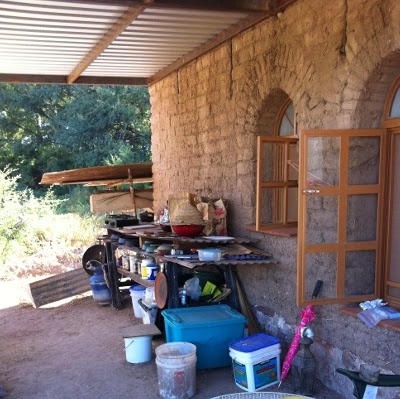
 Since then, he has slowly and meticulously made by hand adobe bricks and has constructed a lovely small home for himself, sourcing as many of the materials locally as possible. During the time he has been working on the building, he has lived in an elderly Sears canvas tent in a sun-dappled grove of mesquite trees, and he has planted food crops in the fields and elsewhere around his living area.

Mesquite grove

The old Sears tent

Ceiling showing catenary arch
The small dwelling has a roof/ceiling that is a catenary arch, all constructed of his handmade adobe bricks. The roof is incredibly strong. One Saturday afternoon recently he got together a group of 15 beefy local cowboys to stand on the roof to demonstrate its durability.

The building has a few arched windows set in the thick strong walls which take the downward force created by the weight of the catenary arch. There is a smooth adobe floor that he will seal with linseed oil, and he has recently painted the interior with whitewash. Near the floor are red and orange colored rocks that he found in the hills near nearby Huepac, and he has carved lovely trailing designs into the adobe at the front and back. Inside the structure, it is light and airy with a beautiful clear energy that is reminiscent of a small cathedral. He says that the local people tell him that all it needs are some saints up front!


Cathedral interior. The adobe floor is still drying.
Window, showing ceiling detail


Scrolls carved into adobe
Stevan spent his last year of college in Thailand, where he learned about sustainable organic farming. Since his classes were online, when he finished, he was able to stay and continue working and learning. During this time he was introduced to natural construction methods and became intrigued with building a home with nothing more than a shovel, a hoe, a bucket and a wooden form for the bricks. He also became involved with the idea of self-reliance and finding all that one needs locally. He later visited Africa to also learn about Nubian vault building, and other adobe construction methods. In the 10 years since then,  he has taught these methods to others, and has built  a number of  projects, preferring to work with owner-builders who are involved with and committed to the building process. He currently has a young apprentice who is learning from him and assisting him.

View to the east with corn crop
After traveling extensively for a number of years, he began to feel the need to settle somewhere. Born in Tijuana, he wanted to stay in northern Mexico in a place where there was water year around. He came across another blog that led him to the Rio Sonora valley. His piece of land is beautiful, with a view across the fields of the mountains to the east and the white domes of the Banámichi church rising above the distant green of the trees. An irrigation canal runs through the mesquite grove. Pretty little yellow-bellied birds zip among the trees, and other small creatures share the space with him. It is a large plot of land, and he has already raised some crops on it. He lunches on salad made of arugula and tomatoes that grow in the mesquite grove. He plans to eventually work the land on a larger scale and raise animals.

Outdoor kitchen showing exterior of the building
I must say that even now, Stevan's lifestyle appeals to me enormously. It is the simplicity, the quietude, the physical activity and the time for introspection that draw me - the same things that keep pulling me back to Banámichi. Stevan will tell you that his is a simple lifestyle, but that it is not necessarily easy. Adobe is heavy stuff. He is lean and muscular from the physicality of it. Still, he says, sometimes when he is hard at work, he looks up and sees the mountains in the distance and he still can't quite believe that he gets to live in such a magnificent place.

Stevan is a gentle soul, an old soul. He is invariably enthusiastic and cheerful, and is solid and secure within himself, knowing what he wants from life. He gets along with everyone. In spite of the challenges of his lifestyle, he seems genuinely happy. He knows that it is the simple things that give him the most pleasure in life. It is deeply satisfying to create his own home, to raise his food, to enjoy his view of the mountains. Sourcing his needs locally eliminates the necessity for dealing with systems that create difficulty and turmoil. He is at peace. It is good to be free from the need for external stimulation. It is better for the person and far better for the planet to live in this manner.

“Live simply so others may simply live.” - Mother Teresa


Saturday, September 21, 2013

World Citizenship

January 1977:   The New Year which we had spent visiting my relatives in Germany had just rolled over. This was the year of Dan's Fulbright Teaching Exchange in England. We were driving through a cold dark fog in Belgium, headed to the ferry from Calais to Dover and back  to where we were staying in Hastings, East Sussex (Hastings in the Battle of Hastings,back in 1066, which was fought in a place nearby appropriately called Battle.)

The feeling of being in an alien place crept over me again. I shivered and sighed. The discomfort of not feeling at home had never really left me since we arrived in England in September. Before we left, I had poo-pooed culture shock as something that happened to other people. England was basically the same culture as ours .... or was it?

Everything was so different than what I was used to. It was cold and dark, a damp seaside climate after living in the Sonoran desert. They drove on the wrong side of the street and the cars were backwards. They used roundabouts instead of traffic lights. I shopped in the High Street, going to the butcher, the baker, and the greengrocer, after being used to supermarkets. All the brands were different. The TV stations were different, the books available to read were different, and we were "The Americans," a constant source of amusement to the locals and unwitting representatives of American culture, whatever that was at the time.

So here I was, a stranger in a strange land, out of sorts with the environment and with myself. We eventually got to the ferry and after an uneventful crossing re-entered England. I looked around. The orange of the sodium-vapor lights was a sudden comfort. We were back on the side of the street that I had reluctantly become used to. Pub signs called out cheerfully and the roundabouts pointing to now familiar places seemed to welcome us. With a huge sigh of relief, I realized I had come HOME...to a place other than the USA!

That experience unsettled me for months and years afterward. I slowly realized that I could never again just sink into unthinking American citizenship the way I once had. My identity had changed and I had instead become a citizen of more than one country...a citizen of the world.

A visit to a Maasai Village, Tanzania
Over the years that has played out in my life in a number of ways. I became very curious about other cultures and open to experiencing as many as I could, as often as possible...the more different the culture from ours, the better. I have now traveled to 42 different countries and 5 continents and the wanderlust has not left me. Each place I visit has something new to teach...it opens me in new ways. With each additional culture or place I visit, my understanding of human nature  runs a bit deeper. I have come to expect the unexpected and not be floored by it as I was in England. In fact I have become able to embrace the unknown and enjoy it, even savor it.

Monks in Jokhang Temple, Lhasa, Tibet
I often think about my mother's family who emigrated from Germany to the USA in the 1920's. They eventually became US citizens, but retained their Germanic ways until they passed away, never fully embracing the US as home. In fact  my Aunt Martha missed the old country so much that  she actually moved back there for a period of time. Instead of this pervasive attachment to a particular place thought of as "home," I have come to realize that the sense of being at home resides within me. As I have come to feel at home in my own body and soul, I have learned that I can move comfortably in strange new places and that I could live just about anywhere and adapt to whatever conditions exist.

Iquitos, Amazon Basin, Peru

World citizenship has also come to mean caring deeply about far flung people and places. I now read carefully news reports of places like Rwanda, the Amazon River basin, and Tibet - places we have been -  with genuine curiosity and deep feeling for the people who live there. World politics have come alive for me. I care about these places and the people who live there. And, when there is famine or natural disaster, I can mentally place myself in the midst of the suffering  and offer heartfelt blessings for the well-being of the people. Compassion has expanded to take in our entire planet. I have learned that every smile, every act of kindness does indeed affect the whole world.

 Marrakesh, Morocco
Knowing that I am a citizen of the world also means that there is no person or group who is truly alien or "other." Looking into the eyes of a veiled woman in a market in Morocco, I saw that she and I were just the same. Dancing in a circle with Maasai women in Tanzania, I felt the same loving bond that I feel with my friends at home. The waves of humanity that surround us in every culture are family. I have learned that people everywhere share the same consciousness. In that sense we truly are one, no matter what culture represents our origin. I have learned that I can open my heart to anyone and extend kindness to them and dwell in our shared humanity.

Near Cappadocia, Turkey
 About a year ago I happened to see online a letter from Helen Chavez, the wife of Cesar Chavez. She had started a petition to the major newspapers to stop referring to human beings as illegal. She said that activities are illegal, people are not. Amen to that. As human beings we all want pretty much the same thing: a place to live, enough to eat, and to live and love as we see fit. Some folks must go to great lengths to achieve that, including crossing borders in search of work. They are neither illegal nor aliens, they are people like us who love their families and want to be able to support them. Instead of jailing them or deporting them, could we not help address the conditions that create the need for them to enter the USA? What if you or I were in their position? How can we help? They are part of our human family. Where is our compassion?

Folklorico Dancers in Banámichi
Which brings me back to Mexico and Banámichi. I love the people here. I love  that they are hardworking, family oriented souls. I  love the surprises and the things I learn from this culture, and I feel totally at home here.Yes, life is a bit different that in the USA. Cowboys ride horses in the streets. The water goes off periodically. The natives celebrate different holidays, care about different politics, are eternally polite, and deal with difficult things less directly than we Americans do. Life may progress more inefficiently, but I am not there to tell the Mexicans how to do things my way, rather to learn what I can from their way.


                                    "We shall not cease from exploration, and the end of all our exploring
                                    will be to arrive where we started and know the place for the first time".
                                    ...T.S. Eliot